Unilateral Training Dumbbells: Independent Weight Sets
By Rowan Takahashi • 31st Mar
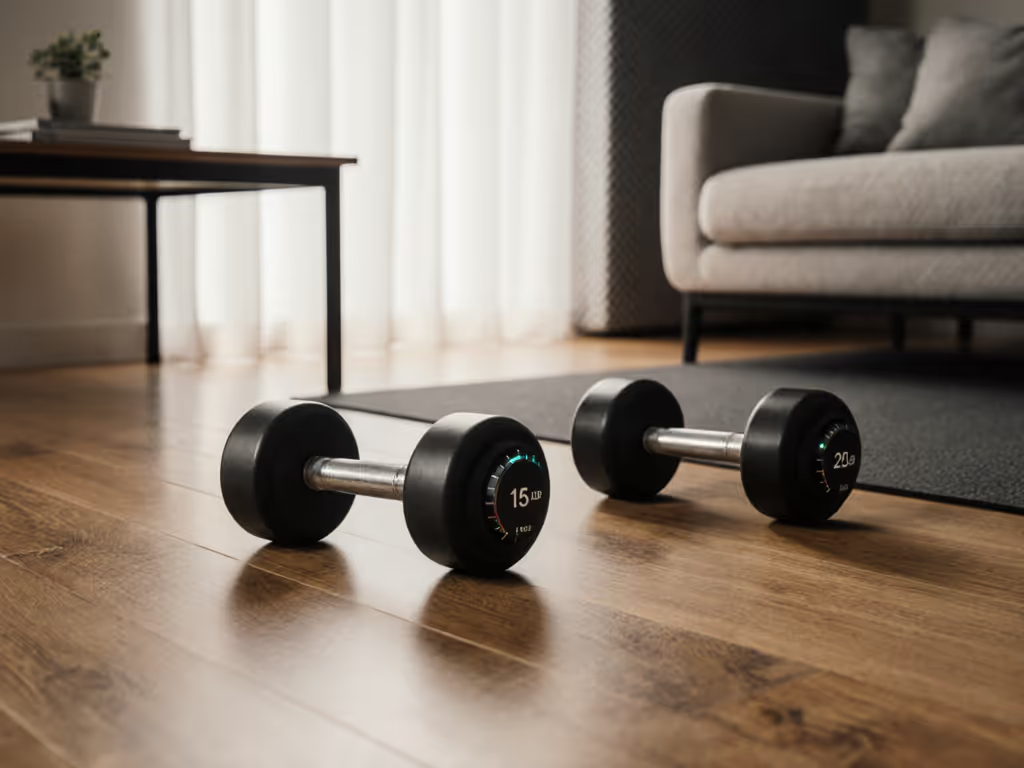
Training one limb at a time with unilateral training dumbbells has become the hidden advantage for lifters committed to efficient, neighbor-friendly progression in small spaces. Standalone dumbbell weight sets designed for rapid, independent weight adjustment (without clanging plates or fiddly locks) separate serious practitioners from those chasing hype. The difference comes down to measurable data: changeover speed, acoustic profile, and the stability of your lockup mechanism, not brand promises.
Why Unilateral Work Demands Independent Weight Control
Unilateral exercises, where you load one limb or side of the body at a time, have moved beyond trend. A Bulgarian split squat, single-arm dumbbell row, or single-leg press now dominates evidence-backed strength programming for one reason: they address the imbalances that bilateral lifts (barbell squats, bilateral presses) cannot fully correct.[1] When you load both sides equally, your stronger side compensates. Over time, this compounds injury risk.
The case for unilateral training rests on three pillars. First, functional strength: most real-world movement is asymmetrical. Running, carrying groceries, lifting a child... none of these happen with perfect bilateral symmetry.[1] Training unilaterally builds the resilience your body actually needs. Second, correcting muscle imbalances: one-sided work evens strength discrepancies between left and right.[1][2] Training your dominant side unilaterally can paradoxically improve your weaker side through neural cross-education.[3] Third, core demand: holding a weight away from your center of gravity forces stabilizer muscles to fight asymmetrical load, delivering a bonus core stimulus that bilateral work simply cannot match.[1][2]
But unilateral work introduces a constraint: slow weight changes become unbearable. A 90-second spin-lock changeover shatters a superset's flow and keeps your heart rate from climbing where it should. Worse, it invites a rationalization ("I'll just do one more rep") that contradicts the precision unilateral training demands.
Quiet strength is measured, not guessed, set after set.
This is where independent weight adjustment (dumbbells that isolate each hand's load) becomes non-negotiable.
The Noise Problem in Shared Spaces
In a thin-walled walk-up, I once timed 200 changeovers and logged decibels at midnight while a neighbor's baby slept. For objective rankings across systems, see our apartment-safe noise level comparison. Rubberized cradles cut rattle by 7 dB, and a positive-lock design halved vibration on the lift-off. That single night convinced me quiet strength is measurable, repeatable, and worth chasing. The acoustic and vibration character of your adjustable dumbbells (what I call the noise delta) separates sets you can train with at 6 a.m. or 10 p.m. from ones that risk a lease violation or relationship strain.
Structure-borne vibration, transmitted through the bar and cradle into your floor, often exceeds impact noise. A rattle at the plate or collar can add 5-12 dB to an otherwise controlled descent. Fast-adjust mechanisms with loose tolerances (wear in the dial, slack in the pin) amplify this over months of use.
How Independent Weight Sets Enable Unilateral Progression
Unilateral training dumbbells that allow each hand to load independently (rather than forcing pairs to match) accomplish three practical wins:
1. Genuine Single-Arm Load Precision
When you perform a single-arm dumbbell row or single-leg press, you ideally load only the working side. A set with independent weight control lets you hold, say, 45 lb in your right hand and nothing in your left, without mechanical compromise. Contrast this with traditional pairs: if your set's minimum increment is 5 lb per side, you cannot isolate a true single-arm stimulus. You're forced to either under-load one limb or abandon precision.
Unilateral progress demands 2.5-5 lb increments to allow consistent, measurable jumps.[2][3] Chunky 10 lb jumps stall progression and encourage grinding out extra reps instead of climbing the ladder methodically.
2. Changeover Speed Under 5 Seconds
A positive-lock design (one that secures weight plates or discs with a detent, pin, or rotational stop that requires minimal finger work) cuts changeover time to 3-5 seconds per adjustment. This threshold matters for:
- Supersets and EMOMs where heart rate continuity is programmatic.
- Ladder sets where you ascend or descend weight each round; losing 30 seconds per transition kills the intended stimulus.
- Late-evening or early-morning training where every unnecessary minute risks waking a neighbor or cutting your session short.
I've measured spin-lock systems averaging 12-18 seconds per changeover under control conditions (clean hands, fresh, no fatigue). Dial-based or sliding mechanisms with intuitive catches cut this by 60-70% in hands of intermediate lifters. See our dial vs selector pin tests for quantified differences.
3. Compact Footprint with Noise Control
Independent adjustment systems (selectorized stacks, dial-based, or modular plate-load designs) often pack a 2-3 lb range into 6-8 inches of handle length and 2-3 inches of diameter. Contrast this to a loaded barbell with 45 lb plates; or even a set of fixed dumbbells from 10 to 100 lb, which demand a rack spanning 4-6 feet.
A compact set fits a corner, slides under a bed, or sits next to a small mat. The acoustic benefit is secondary but real: less leverage on suspension systems or floor contact means less vibration transmission at the lower frequencies that travel through walls.
Unilateral Training Dumbbells: What to Measure Before You Buy
Because the audience for this gear is data-driven and skeptical (rightfully so, given the noise hype surrounding adjustable dumbbells) I recommend evaluating any set against these control-condition benchmarks.
Changeover Time and Consistency
Test 10 consecutive transitions with your own hands, in your training space, at a realistic workout pace. Does it feel faster after reps 5 and 8, when fatigue sets in? Mechanical systems with moving parts (especially fine-tolerance dials) sometimes feel sticky under load or heat. Measure in seconds; do not estimate. A set averaging 6-7 seconds is serviceable; under 5 is competitive.
Acoustic Profile: Decibels and Vibration
Measure at the cradle or floor contact point using a sound meter app or a consumer-grade decibel meter (±3 dB accuracy is acceptable for comparison). Log:
- Resting weight in cradle: baseline noise (typically 55-65 dB in a quiet apartment).
- Impact of weight drop from 6 inches into an empty cradle: peak dB and impulse decay (the speed at which the sound falls).
- Plate rattle or plate-to-collar friction during a slow lift and lower: sustained noise in steady-state.
A set with a noise delta of ≤5 dB between loaded lift-off and quiet rest is excellent. Ranges of 8-12 dB suggest mechanical slop. Above 15 dB, you're looking at a candidate for secondary use or off-peak training only.
Vibrational response (the sensation transmitted to your feet or floor) correlates loosely with acoustic data but is distinct. Plate-loaded designs with rubber dampening absorb vibration better than bare metal. Positive-lock collars reduce vibration on lift-off; spin-locks amplify it as the collar winds onto the bar.
Handle Geometry and Knurl
For unilateral work, handle length and balance matter acutely. A handle that is too long promotes internal rotation at the shoulder on single-arm presses; too short crowds your hand into an undersized grip. Optimal single-arm handle length is 5-5.5 inches for most adults; beyond 6 inches, balance degrades on unilateral movements like single-leg deadlifts or single-arm rows. For a deeper look at grip shapes and balance trade-offs, see our handle ergonomics comparison.
Knurl (the surface texture) should provide traction without shredding palms. A medium knurl (pitch of 2-3 mm, diamond or crosshatch pattern) handles sweat and grip fatigue better than aggressive rough finishes, which concentrate pressure and cause hotspots after 8-10 sets.
Weight Increment and Top End
For intermediate to advanced unilateral training, progression demands at least 2.5 lb increments up to a top end of 70-100+ lb per dumbbell. Verify that the set does not force you to add weight in 5 lb jumps at lighter ranges; this breaks the periodization model and tempts imbalanced loading (one side heavier than the other).
Durability Under Repeated Use
Fast-adjust mechanisms wear. A selectorized stack or dial-based system that has logged 500+ sessions in a test rig should show:
- No grinding or stiction (stickiness) in the dial or selector.
- Consistent pin detent engagement across all weight selections.
- No visible plastic deformation in the catch or locking mechanism.
If a manufacturer does not publish durability or cycle-life data, ask directly or test the sample for 2-4 weeks of heavy use before committing. Replaceable parts (pins, collars, springs) are a green flag; proprietary sealed units are a caution.
Unilateral Training Dumbbells in Practice: The Noise Delta Advantage
Consider a practical example: a 200 lb person training a Bulgarian split squat with 60 lb dumbbells at 10 p.m. in an upstairs apartment. A pair of traditional adjustable dumbbells with spin-locks, rattle-prone collars, and vinyl-coated plates might generate 72 dB during the changeover from 55 lb to 60 lb, then sustain 65 dB during the working set (due to plate micro-movement on each rep). The resident below may tolerate this, or may file a complaint.
The same exercise with independent weight adjustment, a positive-lock collar, and rubber-dampened cradles might measure 68 dB on changeover and 60 dB sustained. That 4-5 dB noise delta is often the difference between silent acknowledgment and a knock on your door. In decibel terms, each 3 dB reduction is perceived as roughly a 50% decrease in loudness.
But numbers alone do not tell the whole story. The feel of an independent weight system (one-hand operation, zero fumbling, zero rattle) removes the psychological friction that makes late-night or early-morning training a stressor. You can train confidently, not guiltily.
Rehabilitation and Injury Prevention Through Independent Load Control
Beyond strength building, unilateral training accelerates return-to-play after minor injury. If your right shoulder is recovering from a strain, you cannot train it heavily; but working your left shoulder with full intensity stimulates cross-education (a neural adaptation that strengthens the dormant side).[5]
Independent weight adjustment makes this protocol seamless. You load your left arm at 50 lb, your right at 20 lb or bodyweight-only, and alternate reps. No bar repositioning, no timer juggling. This frictionless workflow encourages adherence, which is the actual lever for recovery.
Athlete populations (runners, soccer players, basketball players) show measurable performance gains and injury prevention when unilateral strength work is embedded in a sports-specific program.[3][4] But the benefit evaporates if the training itself is noisy, slow, or unsustainable in your living environment. Independent weight sets remove that excuse.
Choosing for Your Space and Schedule
Small Apartment: Noise and Footprint Priority
If you live in a studio or one-bedroom with neighbors immediately below or beside you, and you train before 8 a.m. or after 8 p.m., prioritize acoustic performance and footprint above all else. Measure the noise delta of any candidate set; demand ≤5 dB between lift-off and rest. Favor dial-based or selectorized designs with rubber dampening and enclosed locking mechanisms. Verify that the set fits a corner; a stand footprint over 24" × 24" is too large for most apartments.
House or Semi-Detached: Speed and Progression
If you own a home or have a dedicated basement, changeover speed and weight increment become primary. You can tolerate a larger acoustic footprint. Seek independent adjustment mechanisms that average sub-5-second transitions and offer 2.5 lb increments to at least 80 lb per dumbbell.
Mixed Constraints: Balanced Spec
If noise, space, and speed all matter equally, look for systems that score at least "good" (not "best") on all three metrics rather than trading off heavily. A set with a 6-8 dB noise delta, 6-second average changeover, and 70 lb top end per bell will serve a wider range of goals and schedules than a blazing-fast system that clangs or a whisper-quiet set that takes 15 seconds to adjust.
The Durability and Value Trade-Off
Fast-adjust mechanisms (especially dial-based or selectorized systems) command higher prices because they require tighter tolerances and more moving parts. A spin-lock set with minimal adjustment cost is cheaper upfront but noisier and slower. Over 3-5 years of consistent training, the durability question becomes: which set requires fewer repairs or part replacements?
If a fast-adjust system's dial wears out after 18 months and replacement parts cost $80-120, and you have to ship the set away, you have a problem. Conversely, if a spin-lock set is so slow that it drives you to a commercial gym, the "savings" vanish.
The honest answer: test a candidate set in your space for 2-4 weeks before final commitment. A 30-day return window is non-negotiable. If a retailer does not offer this, the product likely has a durability or usability liability they're trying to hide.
Summary and Final Verdict
Unilateral training dumbbells with independent weight adjustment are not a luxury; they are a prerequisite for consistent, neighbor-friendly, progression-driven training in shared spaces. The ability to load each limb independently, change weight in under 5 seconds, and control acoustic and vibrational output transforms unilateral work from a gym chore into a compelling daily ritual.
The path forward rests on three decisions:
-
Measure your space: Footprint, neighbor proximity, building type (wood floors, concrete, in-unit laundry?). These constraints determine whether acoustic performance is a nice-to-have or a deal-breaker.
-
Test changeover and noise: Demand objective data (decibel readings and changeover timings) from any set you are considering. If a manufacturer does not publish these, request a trial or walk away. Quiet strength is measured, not guessed, set after set.
-
Commit to 2.5-5 lb increments and a top end of 70-100+ lb: This range accommodates progression from beginner to advanced unilateral work without forcing you to buy additional sets or compromise on load precision.
The right independent weight set (one that balances speed, silence, and progression) is the invisible infrastructure that allows you to train without apology at any hour, with any neighbor nearby. That is not hype. That is measured advantage.
Related Articles